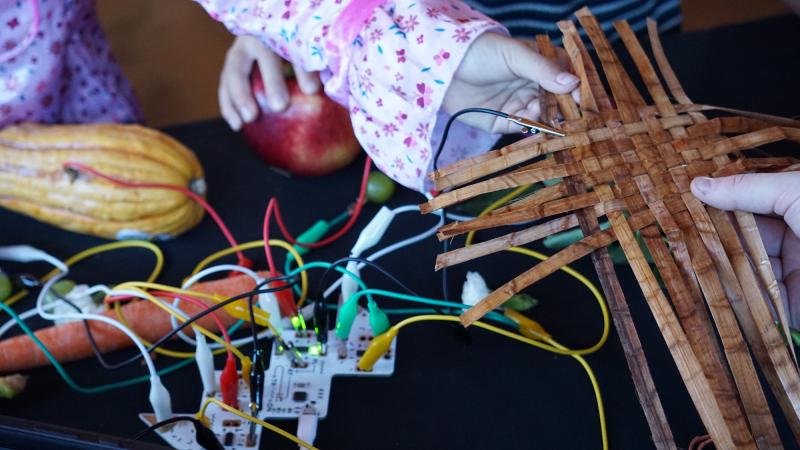
The Ka Moamoa lab draws upon the knowledge and practices of many Indigenous cultures to promote sustainable and community-oriented environmental sensing. We take a relational view on these projects, aiming to build longterm, reciprocal partnerships with Indigenous nations and community organizations. We pride ourselves in designing and deploying robust cyber-physical systems with our partners, meanwhile remaining mindful of the big picture role that computing systems can play within their broader socio-political contexts. The Ka Moamoa lab strives to implement actionable and reciprocal systems that meet the challenges of a rapidly changing world.
Makak: Tribally-Engaged Water Quality Sensing #
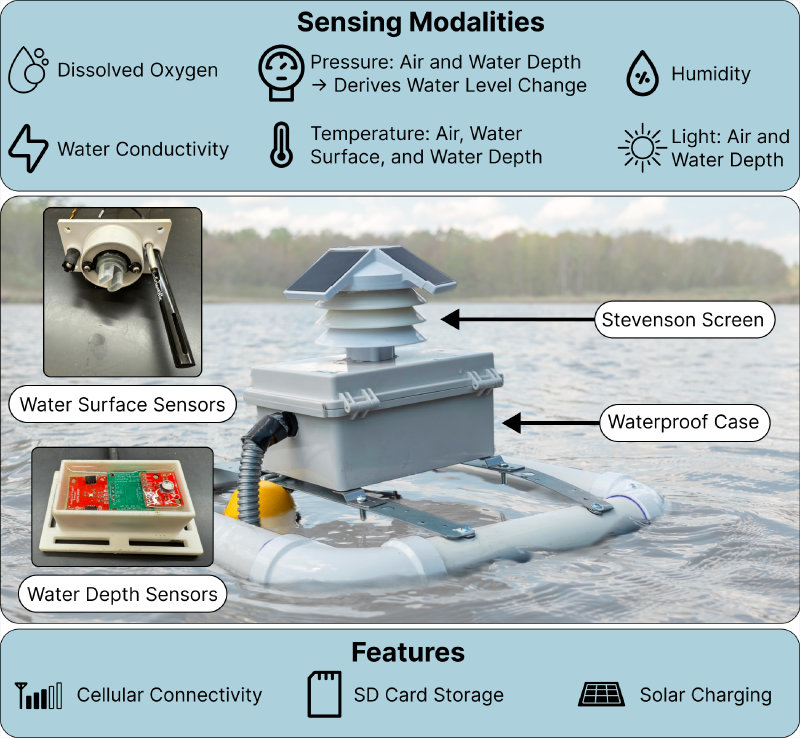
As part of the STRONG Manoomin collective, the Makak project applies sovereignty-centered co-design methods to resilient environmental cyberinfrastructure hardware, supporting Indigenous Ojibwe water stewardship and conservation. The Ojibwe word for “container”, Makak aims to understand the conditions experienced by manoomin (wild rice), a culturally and ecologically significant plant that grows in water bodies in the Great Lakes region and faces a heightened risk from a rapidly changing environment. Grounded in long-term reciprocal relationships, the project moves beyond conventional research paradigms by collaboratively determining what modalities should be measured, how data should be handled, and who governs its use. Through workshops with Tribal Natural Resource elders, shadowing ongoing conservation efforts, and iterative seasonal deployments, the Ka Moamoa lab co-developed low-cost sensing buoys aligned with partners priorities around manoomin (wild rice) conservation, water quality, and sovereignty. From the technical perspective, Makak builds on advances in low-cost sensing, measuring the 10 environmental modalities described in the figure below. The system integrates solar-powered energy harvesting, cellular connectivity, edge computing, and modular environmental sensors into a durable, field-deployable platform. Over the 2024 and 2025 summer seasons, we have deployed 29 Makak buoys with Tribal and other conservation partners to provide realtime data about Ojibwe sovereign lands. Together, the co-design framework and resilient hardware platform demonstrate how community-engaged cyber-physical systems can advance both technical innovation and Indigenous-led environmental stewardship.
Noondawind: A Digital Dashboard for Environmental Stewardship and Tribal Sovereignty #
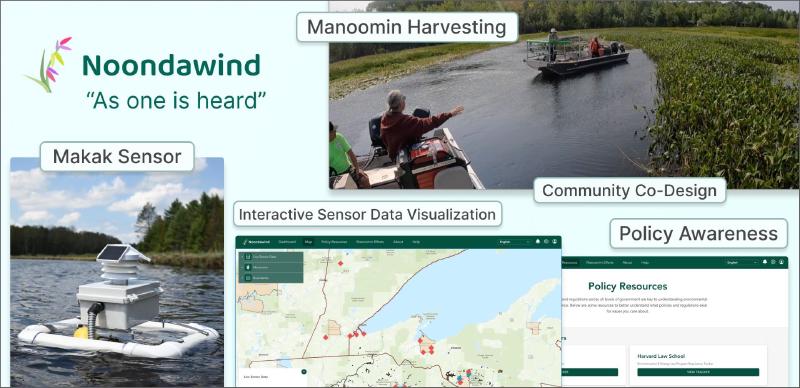
Noondawind is a community data sharing platform designed to support environmental stewardship and data sovereignty for Ojibwe communities in the Great Lakes region. Co-created through long-term partnerships, this project aims to integrate Ojibwe Knowledge with environmental sensing data, community resources, and relevant policy information to support a community-centered platform to drive action. Rather than treating data as neutral or extractive, Noondawind foregrounds relational accountability—ensuring that environmental monitoring, visualization, and data sharing tools reflect partner Nation priorities, cultural values, and intergenerational responsibilities, particularly around the protection of Manoomin (wild rice) and freshwater ecosystems.
The project contributes both a working cyberinfrastructure system and a design framework for sovereignty-affirming technologies. Through participatory design, community workshops, and iterative prototyping, Noondawind demonstrates how data platforms can move beyond technical reporting tools to become instruments of self-determination, decision-making, and seventh-generation stewardship. By centering Indigenous governance, cultural knowledge, and long-term ecological care, the project offers a model for how computing systems can strengthen—not undermine—tribal sovereignty and environmental resilience.
The Makak and Noondawind projects are supported by:
- Strengthening Resilience of Ojibwe Nations Across Generations (STRONG) NSF Smart and Connected Communities Award 2233912
- Focused CoPe: Strengthening Resilience of Manoomin, the Sentinel Species of the Great Lakes, with Data-Science Supported Seventh Generation Stewardship: NSF Coastlines and Peoples Award “Focused CoPe: Strengthening Resilience of Manoomin, the Sentinel Species of the Great Lakes, with Data-Science Supported Seventh Generation Stewardship”, #2209226.
Community-driven Urban Flood Reduction through Sewer Infrastructure Advocacy #
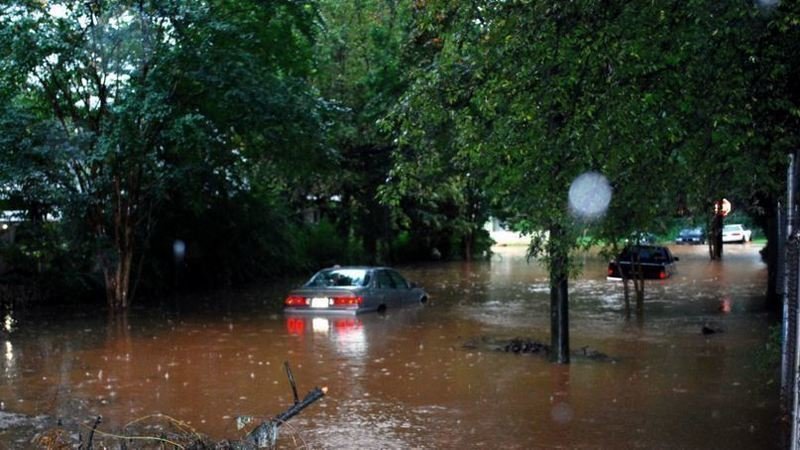
Peoplestown Community Floodwatch is a community-led research partnership focused on addressing chronic combined sewer overflows (CSOs) in Atlanta’s Peoplestown neighborhood. For decades, heavy rains have caused untreated wastewater to flood into residents’ homes, yards, and nearby waterways, creating urgent public health and environmental justice concerns. In collaboration with local leaders, including the Peoplestown Revitalization Corporation, Peoplestown Neighborhood Association, Georgia WAND, Science for Georgia, and the South River Watershed Alliance, our team pairs participatory action research with technical innovation to support resident-led advocacy for long-term infrastructure solutions.
Through storytelling workshops, co-design sessions, and collaborative data analysis, we are building a community-centered flood dashboard and policy advocacy toolkit that aggregates flood maps, planning data, consent decree documents, and lived experiences. These tools will help residents engage city, state, and federal decision-makers to advocate for upstream stormwater retention and equitable infrastructure investment. By strengthening both technological infrastructure (data visualization and modeling) and social infrastructure (relationships, organizing, and civic engagement), the project elevates local voices in advocating for clean water, community health, and environmental resilience in Peoplestown while creating a model for community-driven environmental decision-making nationwide.
Applying Indigenous Relationality to Computer Science Education #
We reimagine how children engage with computing by grounding technology design in Indigenous methodologies of relationality. Rather than prioritizing technical proficiency or isolated learning outcomes, the project positions systems design as a form of stewardship—where relationships with land, materials, and community are central. Through a multi-phase Research–Practitioner Partnership spanning public science festivals, a tribal technology showcase, and a youth engineering internship, we developed tangible user interfaces (TUIs) that transform organic materials—such as fruits, leaves, and cedar bark—into interactive musical and digital systems. By merging the Engineering Design Process with Indigenous frameworks for relational equity and sovereignty, the work demonstrates how technical rigor and cultural accountability can be co-constitutive rather than oppositional.
Across these deployments, youth moved from curious users to sovereign designers—adapting and reimagining the systems for environmental storytelling, generative art, and mental health interventions. The project offers both a working set of relational technologies and a methodological roadmap for Child-Computer Interaction that centers care, reciprocity, and ecological identity development. By treating design as ceremony and technology as a relational mediator rather than a neutral tool, this work provides a scalable model for fostering environmental stewardship, youth agency, and community-rooted innovation through computing.